
You did it.
You took the leap.
You broke away from the traditional, volume-based healthcare system to build something better.
Something focused on patients, not paperwork.
A practice built on relationships, not rushed 15-minute slots.
Whether you call it Direct Primary Care (DPC), concierge medicine, or a membership model, you’re at the forefront of a healthcare revolution.
But now you face a new challenge.
An empty waiting room—virtual or physical—doesn’t build a revolution.
You quickly realize that marketing a relationship is completely different from marketing an appointment. The old playbook just won’t work.
How do you sell a subscription to something people hope they never have to use?
How do you communicate the immense value of access and time in a world conditioned to think in co-pays and deductibles?
I vividly remember a time when a DPC doctor told me they felt more like a startup founder than a physician. They had a beautiful clinic and a powerful mission, but their marketing efforts were falling flat. They were trying to ‘sell’ DPC like a regular check-up, and it wasn’t connecting. That conversation was the turning point that led us to develop a completely new framework for marketing membership medicine.
If you’re feeling that same uncertainty, know this: you’re not alone, and there is a clear path forward.
This isn’t just another blog post.
This is your new playbook.
We’re going to walk you through the essential strategies for successful direct primary care marketing, transforming your practice from a hidden gem into a thriving community.
Why Your Old Marketing Tactics Won’t Work for Your New Model
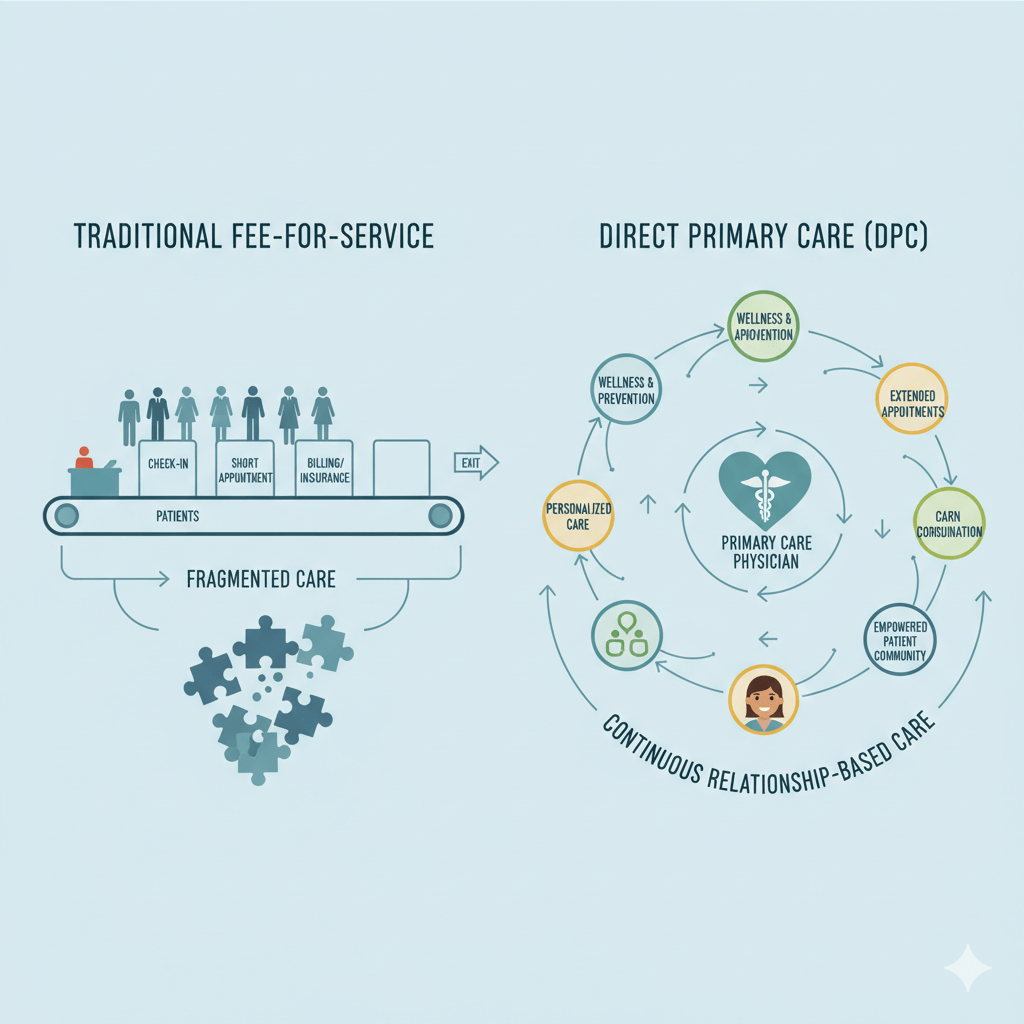
The core of the problem is a fundamental shift in what you’re selling.
Fee-for-service marketing is transactional.
Its goal is to fill a single appointment slot. The patient has a problem, you fix it, the transaction ends.
Membership marketing is relational.
Your goal isn’t to fill one slot; it’s to invite a patient into a long-term wellness partnership.
You aren’t selling a cure for the flu.
You’re selling peace of mind, unparalleled access, and a doctor who truly knows their story.
This is why running a simple “Book an Appointment” ad campaign often fails for a medical membership model.
It targets the wrong mindset.
To succeed, you need to stop thinking like a clinic and start thinking like a community builder.
Step 1: Define What You’re Really Selling
Before you can market your practice, you must be crystal clear on your value proposition.
And spoiler alert: it’s not just “no insurance” or “no co-pays.”
Those are features. Patients buy benefits.
Your first and most critical task is to define the core emotional and practical benefits you offer.
Go Beyond the Features: Uncover Your True Value
Ask yourself these questions, and write down the answers:
- When a patient joins my practice, what feeling are they buying? (Peace of mind? Control over their health? Being heard?)
- What major frustration am I removing from their life? (Waiting weeks for an appointment? Confusing bills? Rushed doctors?)
- What is the ultimate outcome I provide? (A proactive partner in their health? Fewer sick days? Better management of a chronic condition?)
Your answers to these questions are the foundation of your entire marketing message.
How to Articulate Your Value
Once you know what you’re really selling, you need to weave it into every part of your digital presence.
- Your Website Homepage: Instead of “DPC Memberships Available,” try “Imagine a Healthcare Experience Built Around You.”
- Your Service Page: Instead of listing “Longer Appointments,” write “Finally, Appointments Where You Have Time to Ask Every Question.”
- Your Social Media Bio: Instead of “Dr. Smith, DPC Physician,” try “Your Partner in Proactive Health. DPC for busy professionals who value their time and well-being.”
This is a subtle but powerful shift in concierge medicine marketing. It moves the conversation from logistics to life improvement.
Step 2: Build Your Membership Marketing Funnel
A marketing funnel is simply the journey a person takes from first hearing about you to becoming a loyal member. For a subscription model, this journey is all about building trust.
Let’s break it down.
Top of Funnel: Creating Awareness
This is where potential patients discover that a better way to do healthcare even exists.
- Hyper-Local SEO: Many patients want a DPC doctor in their city. Create blog posts and website pages targeting keywords like “direct primary care in [Your City]” or “concierge doctor near me.” This is a powerful, free way to capture high-intent search traffic. An optimized Google Business Profile is non-negotiable here.
- Answer Questions with Content: Create simple blog posts or videos answering the most common questions: “What is DPC?”, “How much does DPC cost?”, “Is DPC worth it for families?”. You become the trusted educator.
- Community Partnerships: Connect with local businesses that serve a similar audience. Think financial planners, small business consultants, or high-end gyms. Offer to host a free “Lunch and Learn” about proactive health for their employees or clients.
Middle of Funnel: Building Trust and Consideration
Someone knows about you. Now, you need to prove you’re the right choice for them.
- The “Meet and Greet”: This is your most powerful marketing tool. Offer a free, no-obligation 15-minute virtual or in-person consultation. This removes the risk for the patient and allows your biggest asset—your personalized approach—to shine.
- Email Mini-Course: Create a simple 3-part automated email series for people who download a guide from your website.
- Email 1: The DPC Philosophy: What it is and why it matters.
- Email 2: A Day in the Life: Show them what it’s really like to be a member.
- Email 3: Answering Your Top Questions & an Invitation to a Meet and Greet.
- Transparent Testimonials: Feature detailed testimonials from current members. Don’t just get a quote; ask them to share the “before and after” story of their healthcare experience.
Bottom of Funnel: Encouraging Conversion
You’ve built trust. Now, make it incredibly easy and compelling for them to join.
- Clear, Simple Pricing: Display your membership fees clearly on your website. Confusion is the enemy of conversion. Avoid hidden fees at all costs.
- Frictionless Sign-Up: Your online sign-up process should be as simple as subscribing to Netflix. The fewer fields and clicks, the better.
- The First 48 Hours: Your marketing doesn’t stop when they sign up. The onboarding experience is crucial for affirming their decision and is your first step toward long-term patient retention.
This entire funnel can be automated, allowing you to build relationships at scale. If setting this up sounds overwhelming, remember that a marketing partner can build this entire patient acquisition machine for you. [Link to Rehabitize’s services page].
Step 3: Master Patient Retention (The Secret to DPC Growth)
In a membership model, growth doesn’t just come from getting new patients.
It comes from keeping the ones you have.
Acquiring a new member can cost 5 times more than retaining an existing one, according to research from HubSpot.
Great patient retention is built on two things: delivering on your promise and fostering a sense of community.
The Onboarding Experience Sets the Tone
What happens in the first week of membership is critical.
- Personal Welcome Call: A 5-minute personal call from you (the doctor) within 48 hours of them joining is unbelievably powerful. It immediately validates their investment.
- A Welcome Kit: This doesn’t have to be expensive. A simple branded folder with a welcome letter, contact information, and instructions for using the patient portal makes the experience feel premium.
From Practice to Community
People will stay for the service, but they’ll become raving fans for the community.
- Members-Only Newsletter: Share monthly health tips, practice updates, or a deep-dive on a wellness topic. Make it exclusive and valuable.
- Private Facebook Group: Create a safe space for members to ask general questions and connect. You can host monthly Q&A sessions or share curated health news.
- Exclusive Events: Host a members-only webinar on a topic like “Navigating Holiday Stress” or a workshop on nutrition. This adds immense value beyond just doctor visits.
By focusing on retention, you create a stable, predictable revenue base and a built-in referral engine.

Your 90-Day DPC Marketing Kickstart Plan
Feeling overwhelmed? Don’t be. Here’s a simple, actionable plan to get you started.
Month 1: Building Your Foundation
- Week 1-2: Finalize your value proposition using the questions from Step 1. Rewrite your website’s homepage to focus on benefits.
- Week 3-4: Completely optimize your Google Business Profile. Add your services, upload high-quality photos, and pre-populate the Q&A section.
Month 2: Planting Seeds of Awareness
- Week 5-6: Write and publish your first two educational blog posts (“What is DPC in [Your City]?” and “DPC vs. Traditional Insurance”).
- Week 7-8: Identify two potential community partners (a local gym, a financial advisor) and draft a simple outreach email to propose a collaboration.
Month 3: Nurturing and Converting
- Week 9-10: Set up a simple system to offer and schedule a “Free Meet and Greet.” Promote it on your website’s homepage.
- Week 11-12: Draft your “Welcome Email” and plan your onboarding experience for your very first new members.
This simple plan focuses on high-impact activities that build momentum without requiring a massive budget.
The Future is Relational, Not Transactional
You chose the medical membership model because you believe in a better future for healthcare.
A future built on trust, time, and genuine human connection.
Your marketing must reflect that future.
It’s not about flashy ads or aggressive sales tactics.
It’s about education, community-building, and generously sharing your value. It’s about building a brand that patients don’t just use, but one they truly belong to.
You have the clinical model to change lives. Now you have the marketing playbook to grow it.
Are you ready to build a thriving DPC or concierge practice?
Launching an innovative practice model requires an innovative marketing partner. If you want to implement these strategies but don’t have the time, Rehabitize specializes in creating bespoke marketing strategies for DPC and concierge clinics.
[Talk to Rehabitize Today to Grow Your Membership Practice]
Frequently Asked Questions (FAQ)
Q1: What is the most important marketing tool for a new Direct Primary Care practice? A1: Your single most important tool is a free “Meet and Greet” consultation. It allows potential patients to experience your value proposition—personalized care and direct access to a doctor—firsthand, which is far more powerful than any ad. It removes the risk for them and builds immediate trust.
Q2: How much should a DPC practice spend on marketing? A2: In the beginning, your budget can be close to zero. The focus should be on “sweat equity” activities like optimizing your Google Business Profile, content creation (blogging), and local community outreach. As you gain members and revenue, you can reinvest 5-10% of your revenue into scalable strategies like targeted social media ads and advanced SEO to accelerate growth.
Q3: Is social media effective for DPC marketing? A3: Yes, but not for direct selling. Use social media to educate and build community. Share health tips, explain the DPC model in simple terms, and introduce your practice’s philosophy. Platforms like Facebook and Instagram are excellent for showcasing the personal, human side of your practice, which is a key differentiator from traditional healthcare.