
The path to your clinic’s door no longer starts with a recommendation from a neighbor or an ad in the yellow pages. It begins with a late-night Google search for a nagging symptom, a question posed in a community Facebook group, or a hunt for the best-rated specialist on Google Maps. The entire process of how a person becomes your patient has fundamentally changed.
Are you still focusing your marketing efforts only on getting that final appointment? If so, you’re missing the critical moments that happen long before—and long after—a patient steps into your office.
Understanding the complete, modern healthcare patient journey is the single most important strategy for sustainably growing your practice. This guide will map out each stage, showing you exactly where you need to be to attract, convert, and retain patients for life.
What is the Healthcare Patient Journey?
The healthcare patient journey is the complete set of experiences a patient has with your practice. It starts from the very first moment they become aware of a health concern and continues through their research, booking, treatment, and post-visit follow-up.
In the past, this journey was relatively linear and offline. Today, it’s a complex, multi-channel, and digital-first process. A potential patient might read your blog post, see your ad on Instagram, check your Google reviews, and then finally visit your website to book—all before ever speaking to your front desk.
Failing to meet them at these digital touchpoints means you’re essentially invisible to the modern patient.
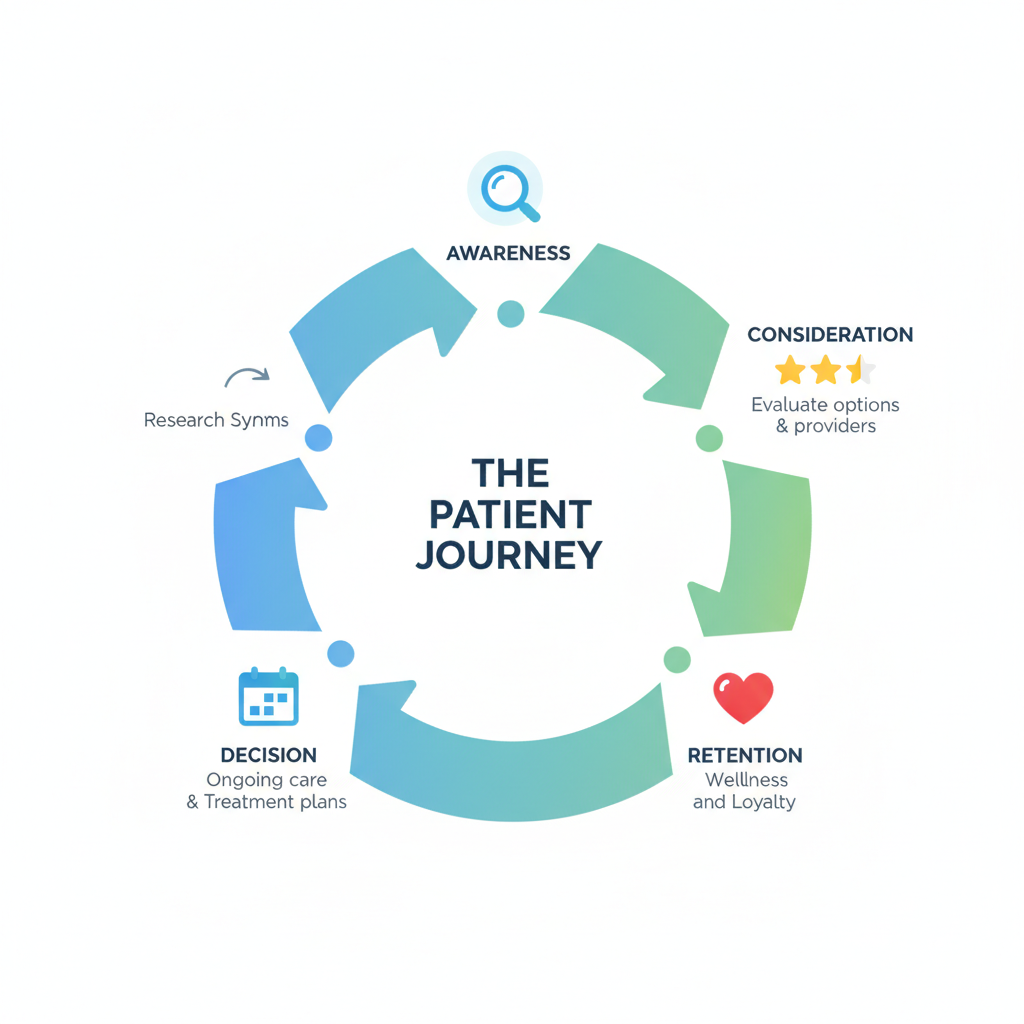
Stage 1: The Awareness Stage – “I Have a Problem.”
This is where it all begins. A person experiences a symptom, has a health question, or realizes they need a specialist. Their first action isn’t to call a doctor; it’s to consult the internet.
Patient Behavior:
- Searching for symptoms: “Why does my lower back hurt when I wake up?”
- Looking for general information: “Best stretches for knee pain.”
- Asking for recommendations on social media.
Your Goal: Be the first helpful, authoritative answer they find. You need to be visible when they are most curious and vulnerable.
SEO: The Foundation of Discovery
Search Engine Optimization (SEO) is non-negotiable in the awareness stage. When a potential patient searches for a condition you treat or a service you offer, your practice needs to appear on the first page of Google. This is achieved by optimizing your website for relevant keywords like “pediatric dentist in [Your City]” or “signs of a torn rotator cuff.”
Effective SEO ensures that when someone in your area has a problem, your practice is presented as a potential solution. Without it, you’re letting your competitors capture every single one of these initial inquiries.
Struggling to get your website to rank on Google? Rehabitize’s SEO & Website Development services are designed to make you the top choice for patients in your area.
Content Marketing: Answering Their Questions
Beyond just ranking for service keywords, you need to answer the questions patients are asking. Creating valuable blog posts, articles, or short videos on topics related to your specialty accomplishes two things:
- It provides more opportunities to rank on Google for long-tail keywords.
- It immediately positions you as a trusted expert, building credibility before they even know they need an appointment.
Stage 2: The Consideration Stage – “Who Can Solve My Problem?”
Once a person understands their problem, they begin actively looking for a solution. They are now evaluating their options and comparing different doctors, clinics, and practices. This is arguably the most crucial stage, where trust is either won or lost.
Patient Behavior:
- Reading online reviews on Google, Healthgrades, and Yelp.
- Visiting clinic websites to learn about doctors and services.
- Comparing social media profiles.
- Looking for patient testimonials and success stories.
Your Goal: Build undeniable trust and make it clear why your practice is the superior choice.
Your Website: Your Digital Front Door
Your website is often the first direct interaction a potential patient has with your brand. A slow, outdated, or hard-to-navigate website is the digital equivalent of a messy waiting room with rude staff. It needs to be professional, mobile-friendly, and provide all the information a patient is looking for, including:
- Clear descriptions of your services.
- Detailed biographies of your healthcare professionals.
- High-quality photos of your team and facility.
- Easy-to-find contact information and hours.
Social Proof and Online Reputation
What others say about you is far more powerful than what you say about yourself. According to recent studies, an overwhelming 94% of consumers say that positive reviews make them more likely to use a business.
In healthcare, this is amplified. Patients are looking for reassurance. Actively managing your Google Business Profile and encouraging satisfied patients to leave reviews is essential for building the social proof needed to win over new patients.
Targeted Social Media and Paid Advertising
This is where you can be proactive. Using platforms like Meta (Facebook & Instagram), you can run targeted ad campaigns to reach specific demographics in your local area. You can even retarget users who have previously visited your website, reminding them of your practice. Use this channel to share patient success stories, introduce your staff, or offer a virtual tour of your clinic.
Are you wasting money on ads that don’t bring in patients? Learn how Rehabitize’s Paid Advertising strategies can fill your appointment calendar.
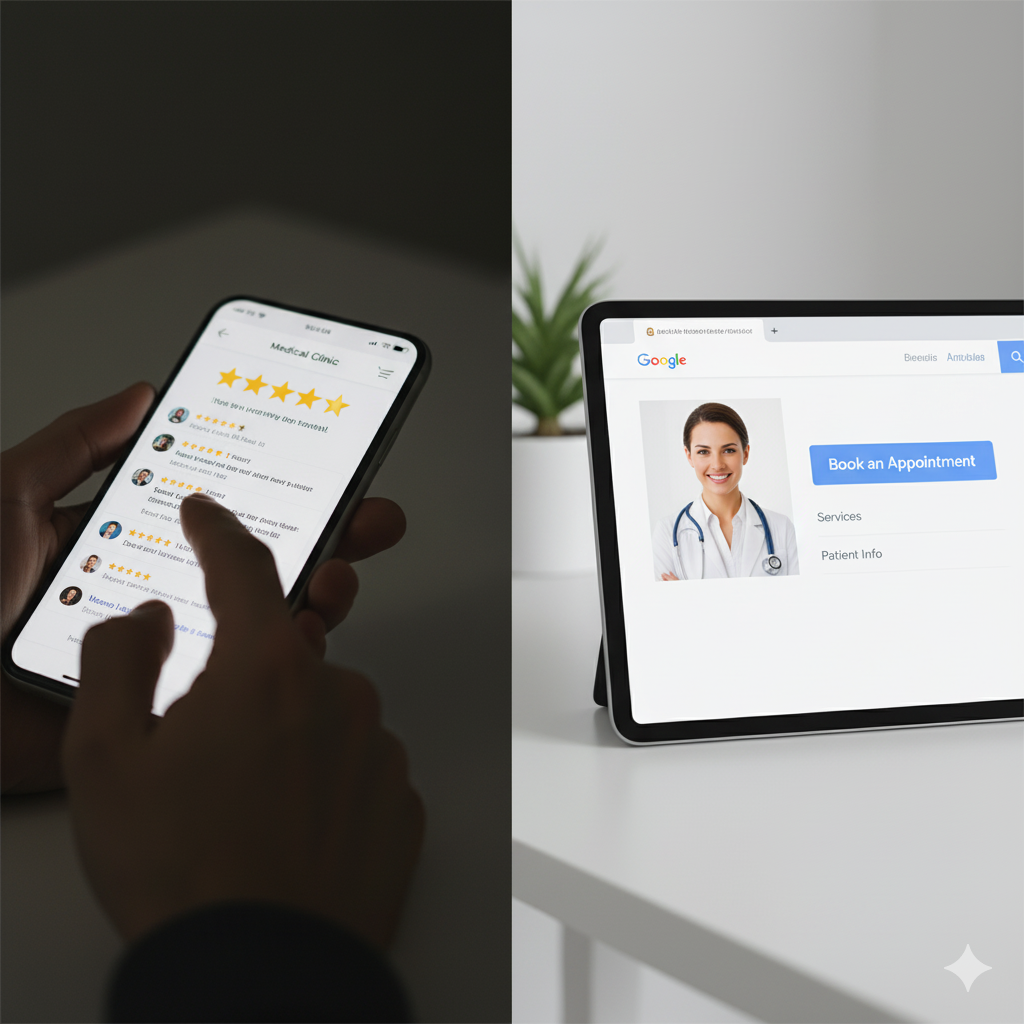
Stage 3: The Decision (Conversion) Stage – “I’m Booking an Appointment.”
The patient is convinced. They’ve done their research, they trust your reputation, and they are ready to take the next step. Your job now is to make that step as simple and frictionless as possible.
Patient Behavior:
- Looking for a “Book Now” or “Request an Appointment” button.
- Calling your office directly from their phone.
- Looking up your address on Google Maps for their first visit.
Your Goal: Eliminate any and all barriers to booking.
Optimizing for Conversion
Every page on your website should have a clear Call-to-Action (CTA). Don’t make potential patients hunt for your contact information. Implement features like:
- An online booking system integrated directly into your site.
- Click-to-call buttons that work seamlessly on mobile devices.
- A simple, short contact form.
The difference between a potential patient and a booked patient can be as small as one extra click.
Google Maps Optimization: The Final Push
When a patient decides to book, they often search for “[Your Clinic Name]” on Google. The first thing they’ll see is your Google Business Profile. If your address is wrong, your phone number is outdated, or your hours are incorrect, you can lose that patient in the final moments. Keeping this profile meticulously updated is a simple but powerful conversion tool.
Stage 4: The Experience & Retention Stage – “I’ll Be Back, and I’ll Tell My Friends.”
You’ve successfully attracted and converted a new patient. The journey isn’t over—in many ways, it’s just beginning. A positive in-clinic experience combined with thoughtful digital follow-up can turn a one-time patient into a loyal advocate for your practice.
As research from the Harvard Business Review has shown for decades, acquiring a new customer is anywhere from five to 25 times more expensive than retaining an existing one.
Your Goal: Nurture the relationship to encourage loyalty, repeat visits, and referrals.
Beyond the Appointment: Digital Follow-Up
Your communication shouldn’t end when the patient leaves. Simple digital touchpoints can make a huge difference:
- Automated follow-up emails with post-treatment care instructions.
- A text message or email a few days later asking for feedback on their experience.
- A direct link to your Google profile to make leaving a review easy.
Building a Community with Social Media
Use your social media channels to keep your patients engaged between visits. Share valuable health tips, clinic news, and behind-the-scenes content. When patients feel like they are part of a community, they are far more likely to remain loyal to your practice.
Want a social media presence that patients love? Rehabitize’s Social Media Management can build that community for you.
Don’t Just Manage Appointments—Manage the Entire Journey
Mapping out your patient journey can feel overwhelming. It requires expertise in SEO, content, web design, advertising, and reputation management. You’re a healthcare professional dedicated to providing the best patient care, not a full-time digital marketer.
That’s where Rehabitize comes in. We understand the complete healthcare patient journey and have proven strategies to engage patients at every single stage.
- We use SEO and Content to make you visible in the Awareness Stage.
- We build Websites and manage your Reputation to build trust in the Consideration Stage.
- We optimize your Google Profile and site for the Decision Stage.
- We use Social Media and follow-up strategies to drive loyalty in the Retention Stage.
If you’re ready to stop waiting for patients to find you and start guiding them to your door, we can help.
Talk to Rehabitize today to build a growth strategy that covers the entire patient journey.
Frequently Asked Questions (FAQ)
Q1: What is the most important stage of the healthcare patient journey? A1: While all stages are vital, the “Consideration” stage is where trust is built or broken. A poor online reputation, a confusing website, or a lack of social proof can lose a potential patient before they ever have a chance to contact you, no matter how great your marketing is in the awareness stage.
Q2: How can I improve my clinic’s online visibility quickly? A2: For immediate results, a combination of targeted Google Ads and an optimized Google Business Profile is a powerful start. For long-term, sustainable growth, investing in a comprehensive SEO strategy and content marketing is the most effective approach to building lasting online visibility.
Q3: Is social media really necessary for doctors and healthcare clinics? A3: Absolutely. In 2025, social media is no longer optional. It is a critical tool for building community, sharing your expertise in a human and relatable way, managing your reputation, and showcasing the patient experience. It plays a key role in both the “Consideration” and “Retention” stages of the journey.